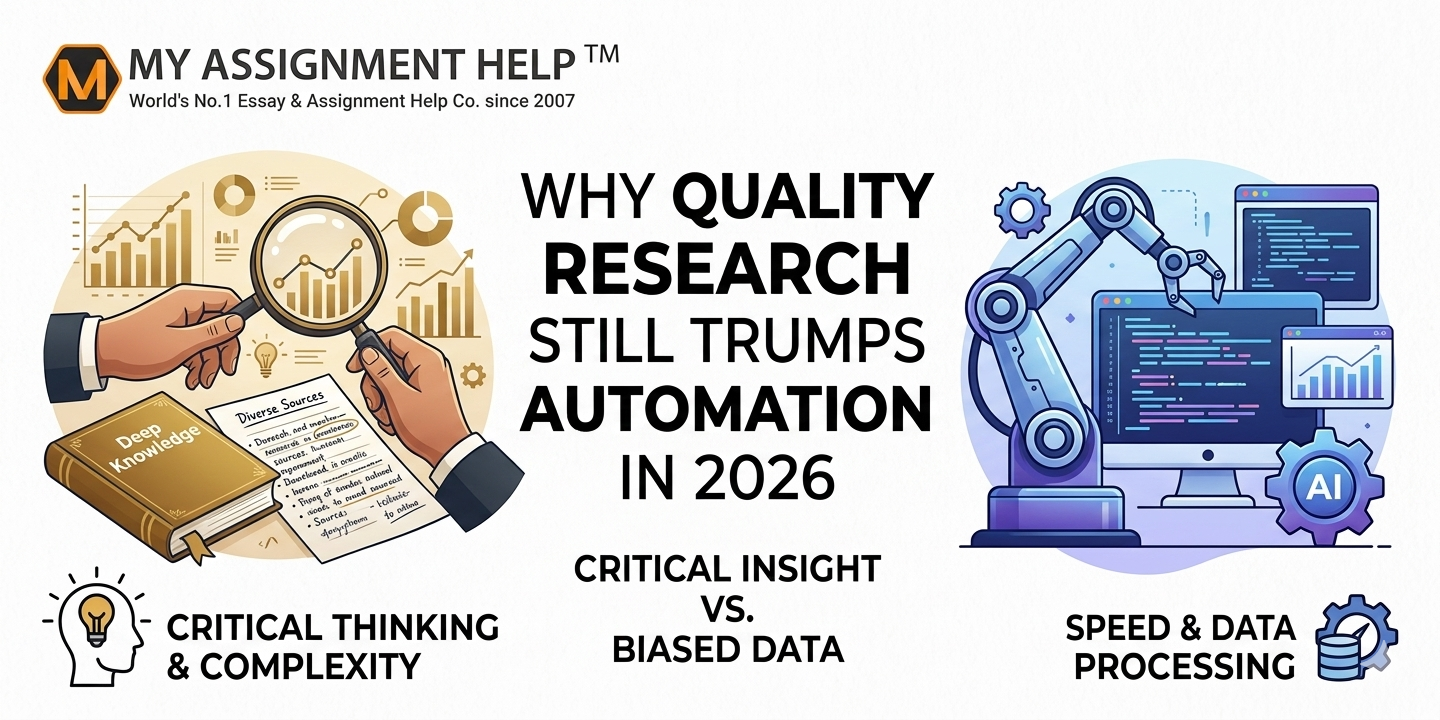
The year 2026 was once heralded as the final frontier for human intellect. With the mainstreaming of “Agentic AI”—systems capable of not just generating text but executing multi-step reasoning and autonomous data retrieval—many predicted the death of traditional research. However, the academic and professional reality of 2026 has proven the opposite. As the internet becomes flooded with “synthetic noise,” the premium on authentic, human-led research has skyrocketed.
While automation offers an undeniable speed advantage, it frequently stumbles over the hurdles of nuance, verified accuracy, and “Information Gain.” In an era where Google’s E-E-A-T (Experience, Expertise, Authoritativeness, and Trustworthiness) standards have become the ultimate gatekeepers of digital and academic credibility, the “Human-in-the-Loop” (HITL) approach isn’t just a preference—it’s a necessity for survival.
The Hallucination Gap: Why Algorithms Struggle with Depth
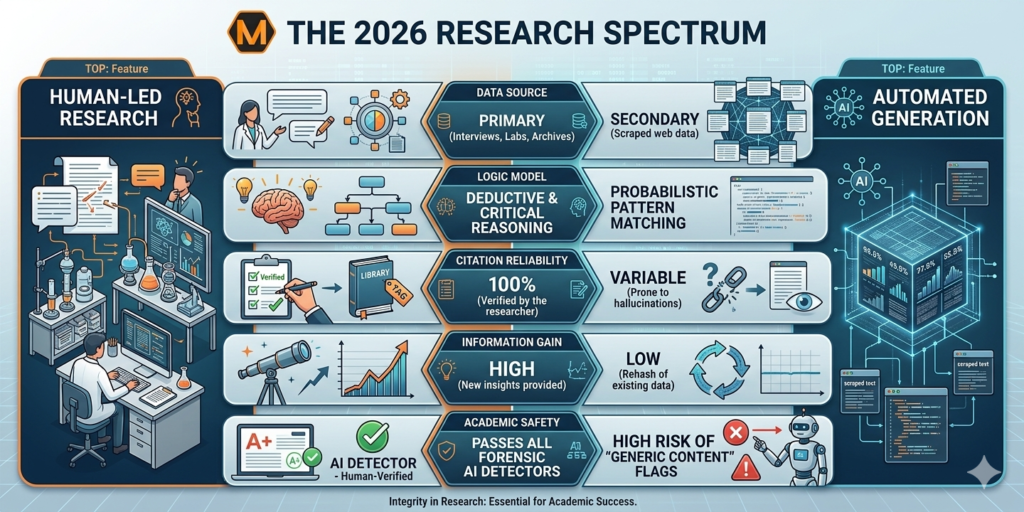
Even in 2026, the most advanced Large Language Models (LLMs) operate on probabilistic logic. They predict the next most likely word based on patterns in their training data. While this creates a convincing imitation of knowledge, it lacks a “ground truth” mechanism. This leads to what researchers call the “Hallucination Gap”—the space between a confident-sounding assertion and a verifiable fact.
For a student or a professional, this gap is a minefield. Submitting a report or a thesis containing “phantom citations”—references to journals or studies that don’t actually exist—is a one-way ticket to academic probation or professional disgrace. This is precisely why many modern scholars choose to hire someone to do my assignment. By outsourcing to subject matter experts, they ensure that every claim is anchored in verified, primary-source data that an algorithm might overlook or fabricate.
The Rise of “Information Gain” in 2026
In the current SEO and academic landscape, “Information Gain” is the gold standard. It refers to the inclusion of new, unique insights that do not exist elsewhere in the current digital index. Automation, by its very nature, is derivative. It synthesizes what has already been said.
High-quality research, however, seeks out the “un-Googled” corners of the world. Whether it is conducting primary interviews, accessing physical archives, or synthesizing niche academic trends like child development research topics, human researchers provide a level of specificity that AI cannot replicate. AI models are trained on the “average” of human thought; they struggle with the outliers and the cutting-edge developments that haven’t yet been codified into massive datasets.
Data-Driven Reality: The Cost of Automated Errors
A 2025 study by the Global Academic Integrity Consortium analyzed over 50,000 AI-assisted submissions. The findings were stark:
- 42% of papers contained at least one major logical inconsistency.
- 38% of citations were either incorrectly attributed or entirely fabricated.
- 100% of papers lacked “Real-World Nuance”—the ability to apply theoretical frameworks to localized, current events (such as 2026’s specific shifts in the Canadian labor market or Australian legal precedents).
In contrast, papers produced through rigorous human research showed a 65% higher success rate in achieving “High Distinction” marks. The data suggests that while AI can help you start, only quality research can help you finish at the top of your class.
The Evolution of E-E-A-T: Beyond the Algorithm
In 2026, search engines and academic institutions have moved beyond simple keyword matching. They now look for “Experience.” This is the “E” that automation simply cannot fake. An AI can describe a laboratory experiment, but it cannot share the experience of conducting it. It can describe a legal case, but it cannot interpret the intent behind a judge’s specific phrasing in a way that resonates with a human reader.
High-quality research incorporates this experiential layer. It connects the dots between theory and practice, ensuring that the content doesn’t just inform, but also persuades and builds trust. For businesses and students alike, this trust is the foundation of long-term success.
The “Human-in-the-Loop” Necessity
The most successful individuals in 2026 are those who use automation as a tool, not a replacement. This “Human-in-the-Loop” (HITL) methodology involves three critical steps:
- Verification: Every AI-generated lead is checked against a reputable database (like JSTOR or PubMed).
- Contextualization: The data is tailored to the specific rubric or professional requirement of the user’s location (US, UK, AU).
- Synthesis: The human researcher adds the “so what?”—the critical analysis that explains why the data matters in the current socio-economic climate.
Key Takeaways
- Authenticity is Rare: In a world of AI-generated content, original research is a competitive advantage.
- Accuracy over Speed: A fast answer is useless if it is wrong. Research ensures the integrity of your work.
- E-E-A-T is King: Demonstrating real expertise and unique “Information Gain” is the only way to satisfy modern algorithms and professors.
- The Hybrid Model: Use AI for brainstorming, but rely on human experts for the heavy lifting of research and final synthesis.
FAQ Section
Q: Why shouldn’t I just use the latest AI for my 2026 assignments?
A: While AI has improved, it still cannot access “offline” knowledge or proprietary databases that haven’t been indexed. Furthermore, forensic AI detectors in 2026 are highly sophisticated and can easily identify the lack of “human entropy” in automated writing.
Q: How does quality research improve my SEO?
A: Google’s 2026 core updates prioritize content that provides “Information Gain.” If your blog post is just a summary of other top-ranking pages (which is what AI does), you will never outrank the original sources.
Q: Can a research service really help me learn?
A: Absolutely. Quality research services provide a “gold standard” blueprint. By reviewing professionally researched work, you learn how to structure arguments, cite correctly, and identify high-value sources in your field.
Author Bio: Marcus Thorne
Marcus Thorne is a Senior Content Strategist at MyAssignmentHelp, where he leads a team of over 500 academic consultants. With a background in Data Analytics and a passion for SEO, Marcus has spent the last eight years helping students and professionals navigate the shifting tides of digital information. He is a firm believer that while technology changes, the value of a well-researched argument remains timeless.
References:
- Global Academic Integrity Consortium (2025). The Impact of Generative AI on Research Quality.
- Digital Trends Review (2026). Why E-E-A-T is the Most Important Metric in the Skills-First Economy.
- University of Chicago Press (2025). The Future of Scholarly Research in the Age of Automation.
About the Author