If you manage infrastructure in 2026, you’re probably living in a weird mix of excitement and stress. AI pilots are turning into real workloads, hybrid cloud is the default architecture, and every renewal conversation somehow ends up circling back to VMware licensing.
That’s exactly why hyperconverged infrastructure keeps showing up in budget decks. The appeal is simple: fewer moving parts, faster provisioning, and less time babysitting storage/network silos.
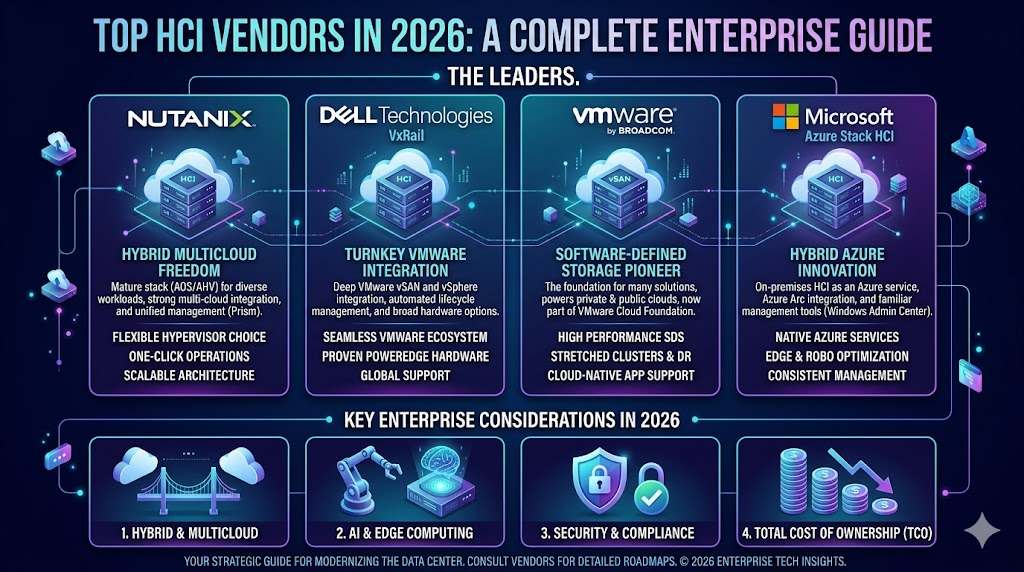
Here’s a practical guide to the top hyperconverged infrastructure vendors you’ll see on shortlists in 2026. It’s specifically tailored for IT folks who want a clean vendor comparison, instead of a glossy brochure making their decision harder.
Why HCI Decisions Got More Urgent in 2026
Two forces are pushing HCI projects forward:
- AI and data workloads are heavier (more GPU conversations, more “why is storage latency spiking?” moments).
- VMware packaging and pricing changes have made a lot of teams re-check their total cost of ownership.
Broadcom-era updates include a 72-core minimum purchase for some VMware subscriptions and a 20% late renewal penalty, which can force faster decisions than most enterprises prefer.
So, yes, many buyers are actively reviewing VMware competitors and weighing an HCI refresh at the same time.
Following the Broadcom acquisition of VMware, Sangfor HCI was recognized by Gartner as a Sample Vendor for VMware alternatives, highlighting its ability to support smoother enterprise migrations with unified management. Adding to this accolade, Sangfor has also been rated 4.8 out of 5 by users on Gartner and 4.7 out of 5 by users on G2.
Top Hyperconverged Infrastructure Vendors that don’t Disappoint
Before we name names, here’s what actually separates good HCI platforms from “we’ll regret this in 18 months” choices:
- Migration realism: Can you move workloads without refactoring everything and without a weekend-long outage plan?
- Day‑2 operations: Does patching, scaling, and troubleshooting feel straightforward, or does it require specialized rituals?
- AI readiness: Not just “supports GPUs”, but can you run and manage GPU-enabled workloads cleanly?
- Licensing clarity: If the quote needs a translator, that’s a risk.
1) Sangfor Technologies
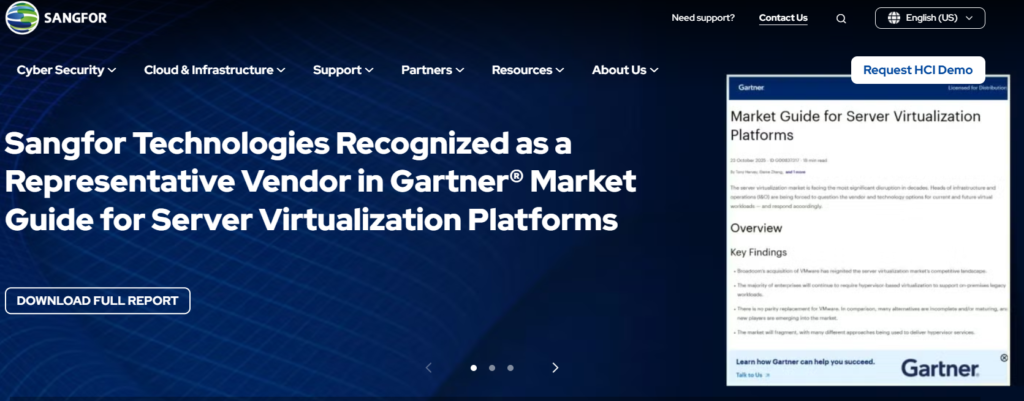
Sangfor positions its HCI as a full-stack, converged platform for modernizing data centers and simplifying management, as a server virtualization software. What makes us show up in shortlists is the “doable migration” story, especially when you don’t want to rewrite apps just to escape licensing pressure. There are also demos showing migration approaches and tooling to help move VMs with minimal complexity.
The best part? Sangfor has a strong community of users backing it up on peer review platforms like G2, with a rating of 4.7 out of 5, making it a reliable VMware alternative to migrate to.
Best fit: teams that want an easier path off VMware and prefer a consolidated platform approach (infrastructure + broader ecosystem support).
Why does Sangfor consistently appear on HCI shortlists for VMware replacement projects?
Sangfor shows up on shortlists because it focuses on practical migration and day‑to‑day operability rather than layered complexity. Its HCI platform combines server virtualization, storage, networking, and security in a single stack, with tooling designed to move VMware workloads without requiring application refactoring. This makes us especially appealing to teams looking for a faster, lower‑risk VMware exit while keeping operations predictable and centralized.
2) Nutanix
Nutanix remains a top pick when you want centralized governance across clusters and locations. Its Nutanix Central is positioned as a unified console for hybrid multicloud visibility and management.
In 2026, Nutanix is also expanding ecosystem integration paths, like the announced collaboration to integrate NetApp ONTAP with Nutanix Cloud Platform, emphasizing modernization without ripping everything out.
Best fit: larger environments that value fleet-level visibility, automation, and ecosystem depth more than “simplest possible HCI.”
3) Dell Technologies VxRail
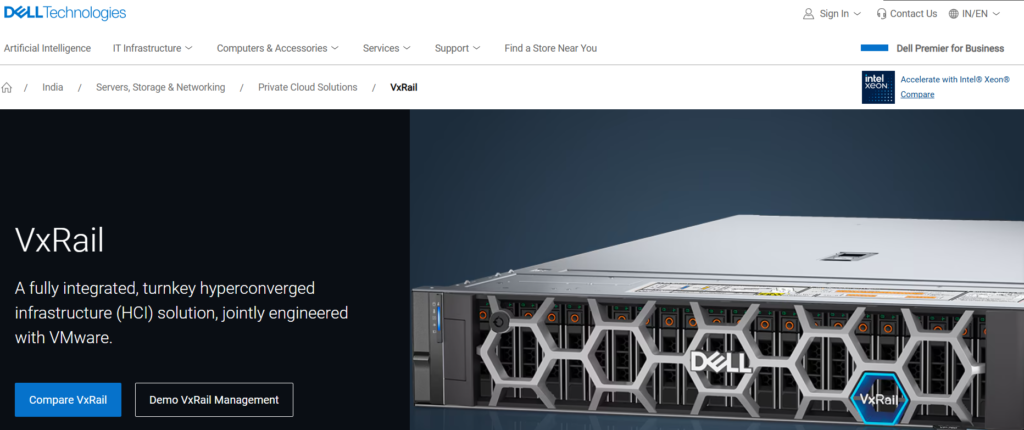
VxRail is still widely considered when organizations want an appliance experience tightly aligned with Dell PowerEdge and VMware vSAN. Dell has highlighted newer VxRail platforms with NVMe options and support for vSAN Express Storage Architecture (ESA) to improve density and performance.
On the AI side, Dell’s ecosystem documentation commonly covers GPU enablement patterns (for example, NVIDIA vGPU in virtualized environments), which is useful if you’re planning VDI, graphics, or certain AI/compute workloads.
Best fit: “We’re staying VMware-aligned, but we want a modern, integrated HCI system with solid lifecycle management.”
4) Microsoft Azure Local
Microsoft’s Azure Stack HCI has evolved under the Azure Local name, and Microsoft’s March 2026 release notes emphasize cloud-based deployment/updates, monitoring, security improvements, and a simplified VM management experience.
It also supports GPU scenarios in the current release stream, which matters more now that edge AI and on-prem inference are becoming real projects.
Best fit: Microsoft-centric shops that want Azure-style management and governance extended on-prem.
5) Cisco
This is a key 2026 reality: Cisco announced end-of-life for HyperFlex Data Platform (HXDP) and points customers to Cisco Compute Hyperconverged with Nutanix as the alternative. Cisco also documents what happens to entitlements, support, and roadmap commitments in its official FAQ.
Best fit: organizations that standardized on Cisco hardware and want a supported transition path away from HyperFlex.
6) Scale Computing
Scale Computing focuses heavily on simplicity for distributed environments. It has publicly positioned SC//HyperCore as a lightweight, resilient platform with “self-healing” capabilities and enhancements like improved node lifecycle management.
If you run lots of small sites (retail, clinics, plants), this matters because you don’t want edge clusters that require constant onsite attention.
Best fit: edge and multi-site operations where “simple, stable, centrally manageable” beats “maximum enterprise feature depth.”
7) HPE GreenLake
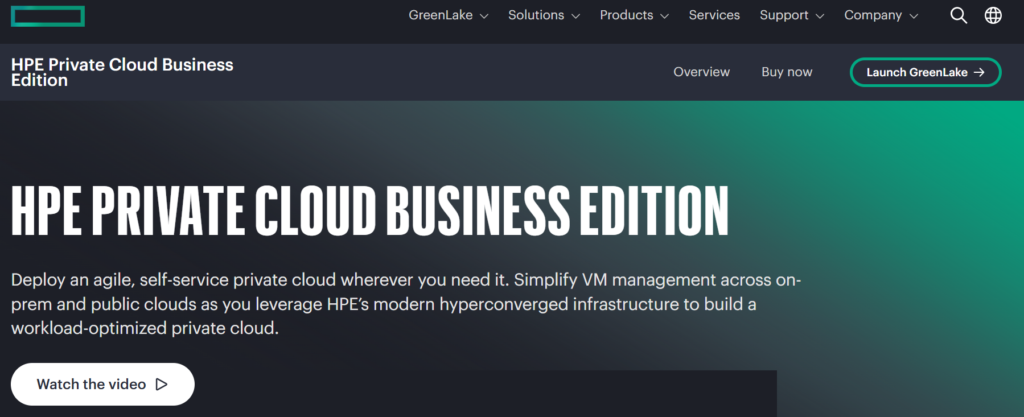
HPE’s GreenLake direction appeals to organizations that want consumption-style economics and operational dashboards. HPE’s Sustainability Insight Center messaging highlights visibility into energy usage, costs, and emissions across hybrid environments.
SDxCentral also covered HPE’s sustainability dashboard approach, using telemetry and regional grid carbon intensity to report energy and carbon impact.
Best fit: enterprises that want cloud-like consumption plus governance and sustainability reporting to become part of infrastructure KPIs.
Strategic Buying Factor
When migrating to a new platform for your enterprise IT needs, IT leaders must ask themselves the following questions:
Can You Reuse Existing Hardware?
Some approaches are appliance-first, while others are more software-defined and flexible, which is important if you’re trying to reduce waste and avoid unnecessary refresh costs during a VMware transition.
How Painful Will The Migration Be, Really?
With VMware licensing shifts (core minimums and renewal penalties), migration timelines can get compressed fast. Prioritize vendors that publish clear migration steps and tooling, not vague promises.
What Does “AI-Ready” Mean For You?
For many teams, it’s not “GPUs everywhere.” It’s “a few GPU-capable nodes, clean management, and predictable performance.” Microsoft and Dell both emphasize GPU-related enablement paths in their ecosystems and documentation.
What should enterprises prioritize when narrowing down HCI vendors in 2026?
Enterprises should prioritize migration realism, licensing clarity, and operational simplicity over feature checklists. The right HCI platform, like Sangfor’s, should support phased, low‑downtime migrations, offer transparent licensing without forced bundles, and handle day‑2 operations, such as patching, scaling, and troubleshooting, without specialized expertise. These factors matter more in 2026 as compressed VMware timelines, AI workloads, and hybrid cloud demands leave little room for platform friction.
How to Shortlist HCI Vendors in 2026
The right HCI vendor is the one that gets most of your enterprise needs right and fulfills them without complexity. For example, if your priority is VMware exit + operational simplicity, Sangfor is worth a serious look. Also, if you want a mature hybrid control plane, Nutanix is hard to ignore. On the other hand, if a tight VMware-aligned appliance experience is your priority, you can choose VxRail.
But when it comes to having a simplified and more affordable HCI that handles most of your enterprise needs without much hassle, Sangfor is the solution. So, what’s your IT need? Which HCI vendor would you rather choose this year? Let us know in the comments.
About the Author