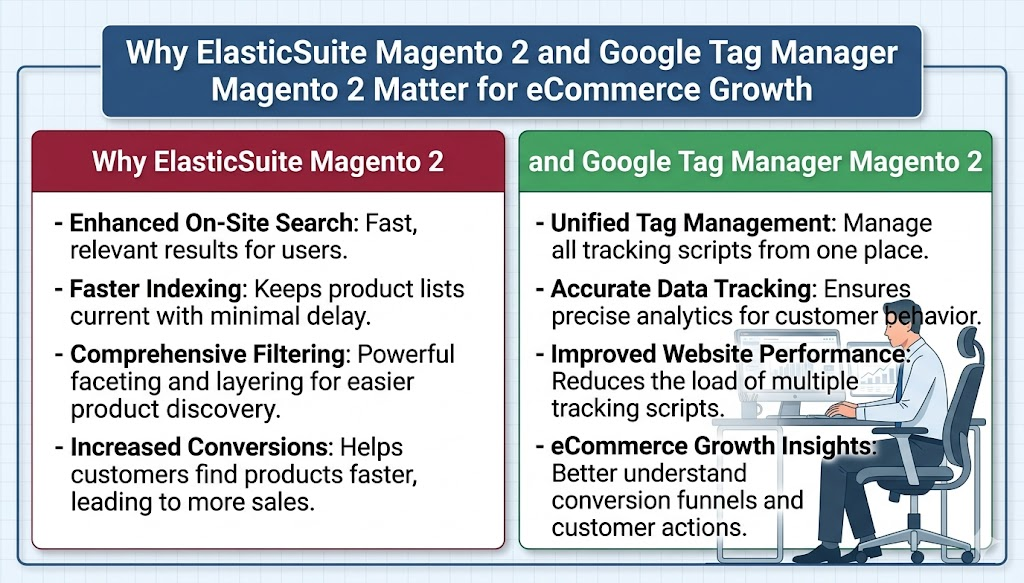
Running an online store today feels more competitive than ever. Every store owner wants better traffic, higher sales, and smoother shopping experiences. Yet many Magento stores still struggle with slow search results, poor product discovery, and weak customer tracking.
That is where ElasticSuite Magento 2 and Google Tag Manager Magento 2 become valuable tools. Together, they help stores improve customer experience and understand buyer behavior better.
Modern shoppers expect fast searches and relevant products. They also expect smooth browsing on every device. If your store fails here, customers leave quickly. That directly affects revenue and long-term growth.
Magento already offers powerful eCommerce features. Still, smart extensions and tracking tools can unlock much better performance. Many successful brands rely on these solutions daily.
This guide explains how these tools work together. You will also learn how Magento experts like Amasty help businesses build stronger stores with better customer experiences.
What Is ElasticSuite Magento 2?
ElasticSuite Magento 2 is an advanced search and merchandising solution for Magento stores. It improves how customers search products and discover items across the store.
Basic store search often delivers weak results. Customers may type exact product names and still fail to find items. That creates frustration quickly.
ElasticSuite solves this issue using smarter search technology. It uses Elasticsearch to deliver fast and highly relevant results. Customers receive accurate suggestions instantly.
The extension also supports layered navigation, virtual categories, and autocomplete features. These features improve product discovery naturally.
Store owners benefit as well. They can control product rankings and search behavior more effectively. This creates a better shopping journey for every visitor.
Many Magento developers recommend ElasticSuite because it scales well with growing stores. It also handles large product catalogs efficiently.
Why Search Experience Matters in Magento Stores
Search plays a major role in eCommerce success. Visitors who use search often convert faster than regular browsers.
Customers usually search when they already know what they want. A strong search system helps them purchase faster.
Poor search functionality creates serious business problems. Customers may leave without finding products. Bounce rates also increase significantly.
ElasticSuite Magento 2 improves search quality through advanced filtering and smart relevance scoring. Customers receive products matching their intent more accurately.
This creates smoother customer journeys and better user satisfaction. It also increases average order value over time.
Good search improves SEO performance too. Search pages often become valuable landing pages for organic traffic.
That means better visibility and more opportunities for sales growth.
Key Features of ElasticSuite Magento 2
ElasticSuite offers many advanced features for Magento stores. These features improve both customer experience and store management.
Smart Autocomplete
Autocomplete helps customers find products faster. Suggestions appear instantly while users type.
This reduces search effort and improves usability. Customers feel guided naturally through the buying process.
Advanced Filtering
Customers can filter products using multiple attributes. They can refine searches by brand, size, color, price, and more.
This helps shoppers narrow results quickly. It also improves conversion opportunities.
Virtual Categories
Virtual categories allow dynamic product grouping. Products appear automatically based on selected conditions.
This saves store owners valuable time. It also keeps product collections updated continuously.
Relevance Optimization
ElasticSuite Magento 2 lets merchants control search rankings. High-priority products can appear first.
This feature supports promotional campaigns and seasonal products effectively.
Elasticsearch Integration
Elasticsearch delivers fast and scalable performance. Large Magento stores especially benefit from this capability.
Customers enjoy faster page responses and accurate search experiences.
Understanding Google Tag Manager Magento 2
Google Tag Manager Magento 2 helps store owners track customer behavior efficiently. It simplifies website tracking without heavy coding work.
Tracking is essential in modern eCommerce. Without analytics, stores cannot improve customer experiences effectively.
Google Tag Manager allows marketers to manage tracking tags from one dashboard. This reduces development dependency significantly.
Magento stores use many tracking tools today. Examples include Google Analytics, Facebook Pixel, and conversion tracking scripts.
Managing these scripts manually often becomes difficult. Google Tag Manager solves this challenge cleanly.
It helps businesses deploy tracking changes faster and more accurately.
Why Tracking Matters for Magento Stores
Data drives better business decisions. Every successful eCommerce brand relies on customer insights.
Without proper tracking, stores operate blindly. Owners cannot understand what works or fails.
Google Tag Manager Magento 2 helps track important customer actions. These include product views, cart additions, purchases, and checkout steps.
This information helps improve marketing strategies continuously.
For example, stores can identify abandoned cart issues quickly. They can also optimize product pages using customer behavior data.
Tracking also supports advertising campaigns better. Businesses can measure return on investment more accurately.
That means smarter spending and stronger growth opportunities.
Benefits of Using Google Tag Manager Magento 2
Google Tag Manager provides many advantages for Magento store owners and marketers.
Faster Tag Management
Teams can add tracking codes without editing store files constantly. This saves development time significantly.
Marketing teams also gain more flexibility.
Better Analytics Accuracy
Google Tag Manager reduces tracking mistakes. Proper setup improves data reliability across platforms.
Reliable data supports smarter business decisions.
Improved Website Performance
Manual scripts can slow Magento stores. Tag Manager organizes scripts more efficiently.
This helps maintain better page speed performance.
Easier Conversion Tracking
Businesses can track sales funnels clearly. They can understand where customers drop off during checkout.
This helps improve conversion optimization strategies.
Enhanced Marketing Campaigns
Google Tag Manager Magento 2 supports advertising platforms easily. Businesses can track campaigns across multiple channels.
This improves audience targeting and campaign performance.
How ElasticSuite Magento 2 and Google Tag Manager Magento 2 Work Together
These two tools serve different purposes. Yet together, they create stronger Magento stores.
ElasticSuite improves customer experience through better search functionality. Google Tag Manager improves business insights through accurate tracking.
For example, stores can track search behavior directly. They can monitor what customers search most often.
This data becomes extremely valuable for merchandising strategies.
Businesses can discover missing products or poor-performing categories quickly. They can also identify customer demand trends.
Tracking search refinements also reveals user frustration points. Store owners can then optimize search settings accordingly.
This combination improves both customer satisfaction and business intelligence.
Common Challenges Magento Stores Face
Many Magento stores struggle with technical and operational issues. Search and analytics problems remain especially common.
Weak Search Results
Default Magento search sometimes fails with spelling mistakes or broad queries. Customers may struggle finding products.
ElasticSuite Magento 2 solves this challenge effectively.
Slow Store Performance
Heavy product catalogs can affect speed negatively. Slow pages reduce conversions significantly.
Elasticsearch helps improve response times and scalability.
Incomplete Customer Data
Without proper tracking, businesses lose valuable insights. Marketing strategies become less effective.
Google Tag Manager Magento 2 improves tracking visibility across customer journeys.
Complex Tag Management
Manual code updates increase errors and delays. Marketing teams often depend heavily on developers.
Google Tag Manager simplifies this process greatly.
Best Practices for ElasticSuite Magento 2
Using ElasticSuite correctly matters greatly. Proper optimization delivers better customer experiences and stronger results.
Optimize Product Attributes
Well-structured product attributes improve search relevance. Use clear titles and detailed product descriptions.
This helps ElasticSuite deliver accurate search matches.
Monitor Search Analytics
Review customer search terms regularly. Identify products customers cannot find easily.
This helps improve catalog structure continuously.
Use Synonyms
Customers use different words while searching. Synonym management improves product discoverability naturally.
For example, “sneakers” and “running shoes” may refer to similar products.
Improve Category Navigation
Layered navigation should remain simple and clear. Too many filters can confuse customers.
Focus on useful filtering options only.
Best Practices for Google Tag Manager Magento 2
Correct implementation improves tracking quality and business reporting.
Create Clear Tag Structures
Organize tags properly inside containers. Use naming conventions consistently.
This reduces confusion during future updates.
Test Every Tag
Always test tracking before publishing changes. Incorrect tags can damage analytics accuracy.
Use preview tools to verify data carefully.
Track Important Customer Actions
Focus on high-value interactions first. Examples include purchases, cart additions, and product clicks.
These metrics provide meaningful business insights.
Avoid Too Many Scripts
Too many tracking scripts affect performance negatively. Keep only essential tags active.
This helps maintain fast page loading speeds.
Why Magento Expertise Matters
Magento is powerful but complex. Poor implementations often create long-term problems.
Professional Magento developers understand platform architecture deeply. They can optimize performance, security, and scalability effectively.
That is why many businesses work with experienced Magento partners like Amasty.
The company has years of Magento ecosystem experience. Their solutions support thousands of eCommerce businesses globally.
They understand real-world Magento challenges clearly. Their extensions and development expertise help businesses improve store functionality safely.
Experienced Magento specialists also prevent costly mistakes. This saves businesses time and technical frustration.
SEO Benefits of ElasticSuite Magento 2
Search engine optimization remains critical for eCommerce growth. ElasticSuite supports SEO improvements naturally.
Better internal search improves customer engagement metrics. Visitors stay longer and explore more products.
This creates positive behavioral signals for search engines.
Layered navigation and structured product discovery also improve indexing opportunities.
Customers finding products faster usually convert better too. Strong user experience supports SEO performance indirectly.
Fast-loading search results also improve mobile usability. Mobile experience matters heavily for modern rankings.
How Better Analytics Improve Revenue
Data-driven decisions often outperform assumptions. Businesses using analytics effectively grow faster.
Google Tag Manager Magento 2 helps uncover valuable customer insights. These insights guide smarter marketing and merchandising strategies.
For example, stores can identify top-performing products easily. They can also discover weak checkout areas quickly.
This allows continuous optimization across the customer journey.
Businesses can improve advertising campaigns using conversion data too. Better targeting often reduces wasted spending.
That creates stronger profitability over time.
The Future of Magento eCommerce
Customer expectations continue evolving rapidly. Stores must adapt continuously to remain competitive.
Search personalization will become even more important. Customers expect highly relevant shopping experiences.
Advanced tracking and customer analytics will also grow in importance. Businesses need accurate data for personalization strategies.
ElasticSuite Magento 2 supports advanced search experiences already. Google Tag Manager Magento 2 supports smarter data collection and marketing optimization.
Together, they create a strong foundation for long-term eCommerce success.
Businesses investing in customer experience and analytics today will remain more competitive tomorrow.
Final Thoughts
Magento remains one of the most powerful eCommerce platforms available today. Yet success depends on how stores use its capabilities.
ElasticSuite Magento 2 improves customer search experiences dramatically. Customers find products faster and enjoy smoother shopping journeys.
Google Tag Manager Magento 2 helps businesses understand customer behavior clearly. Accurate data supports smarter marketing and better decisions.
Together, these tools improve both customer satisfaction and business performance.
Working with experienced Magento experts also matters greatly. Trusted Magento specialists like Amasty help businesses build scalable and optimized eCommerce stores confidently
About the Author