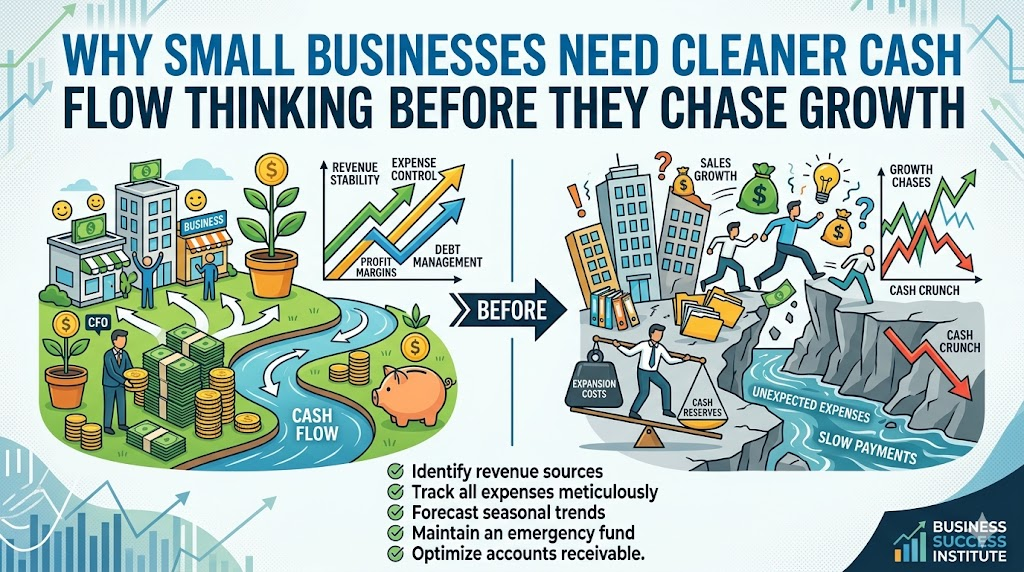
When businesses talk about growth, they think of more customers and bigger invoices. Also, they think of a larger team and maybe a new office with better chairs and fewer broken coffee machines.
Still, behind all that noise, small-business growth depends mostly on cash-flow discipline. Although it is less exciting, it is much more decisive.
Many businesses do not fail because their ideas are weak. Instead, they stumble because money moves in scattered patterns.
- Revenue arrives late.
- Bills arrive early.
- Tax obligations sit quietly in the corner until they suddenly become urgent.
Therefore, finance is no longer just an accounting function. Rather, it is the business’s operating system.
Cash Flow Is Not Merely Money Coming in
At the outset, a company might look healthy on paper. Still, it might feel like it’s being squeezed every week. That is the uncomfortable bit. For instance, sales may rise. However, if collections lag or expenses expand too quickly, the owner still ends up juggling payments.
Additionally, modern businesses face thinner margins, faster vendor cycles, and customers who expect flexible payment options. Because of this, owners must understand the timing of money rather than merely its amount. For instance, a $20,000 invoice due in 45 days does not help much when payroll hits next week.
Tax Planning Needs to Happen Before Tax Season
Most businesses treat tax planning like an annual panic ritual, which is not ideal. For freelancers, consultants, contractors, and small firms that use flexible talent, estimated taxes become a real pressure point.
This happens especially if no one tracks liabilities throughout the year. Consequently, better forecasting matters.
This is where tools such as a 1099 Tax Calculator support better decision-making in a positive, practical way. Basically, it gives independent professionals and business owners a clearer sense of what to set aside. Hence, they get fewer ugly surprises later. Moreover, it encourages them to treat tax as part of pricing rather than an afterthought.
A Cleaner View of Business Finance
Sometimes, business owners chase revenue while ignoring financial structure. However, revenue without controls creates false confidence. For instance, a company may sell more, hire faster, and spend aggressively. Still, they might lack the liquidity needed to survive a slow quarter.
| Financial Area | Common Mistake | Better Approach |
| Revenue | Treating sales as available cash | Track invoice timing and collection risk |
| Expenses | Expanding fixed costs too early | Keep costs more flexible during uncertain growth |
| Taxes | Waiting until filing season | Estimate obligations monthly or quarterly |
| Pricing | Copying competitors | Build prices around margin, tax, labor, and risk |
| Debt | Borrowing for momentum only | Match debt to measurable returns |
Meanwhile, financial maturity does not require corporate complexity. Rather, it requires rhythm –
- Weekly cash reviews
- Monthly margin checks
- Quarterly tax planning
Although these are simple routines, they help keep the business honest.
Debt Can Help, But Only With a Purpose
Obviously, debt is not automatically dangerous. In fact, it helps a business buy equipment and manage seasonal demand. Also, they help businesses enter a new market.
Nevertheless, debt becomes risky when it is tied to weak margins or poor planning. That is when borrowed money turns into a delay button rather than a growth tool.
Therefore, owners should ask sharper questions before taking loans or credit lines.
- Will this money increase capacity?
- Will it reduce costs?
- Does it offer the ability to generate measurable revenue within a defined period?
If the answer feels vague, the decision probably needs more work. Hence, it is important to follow the steps below:
- Compare repayment schedules against actual cash inflows rather than optimistic sales targets.
- Separate emergency borrowing from expansion borrowing.
- Review whether debt improves margins or merely hides operational waste.
- Keep enough reserve to survive delayed payments or weaker demand.
The Real Finance Skill Is Trade-Off Thinking
Primarily, good business finance is not merely about saving money. Sometimes the cheaper vendor causes delays. In some cases, the higher-paid specialist prevents expensive mistakes.
Likewise, automation may cost more upfront. However, it might reduce administrative drag later. So the real skill is not penny-pinching, but trade-off thinking.
Additionally, small firms need to know which numbers deserve attention. Basically, gross revenue gets attention because it feels big. However, the following factors usually tell the truer story:
- Net margin
- Cash conversion
- Tax exposure
- Customer acquisition cost.
Financial Discipline Makes Growth Less Fragile
In general, a business with clean books, realistic forecasts, and steady reserves moves faster when an opportunity appears. Conversely, a business with scattered finances has to hesitate. In fact, it cannot do the following:
- Price confidently
- Hire confidently
- Invest without anxiety.
Eventually, that uncertainty becomes a competitive disadvantage.
Therefore, growth should not begin with “How much can this business sell?” Rather, a better question is, “How much growth can the business absorb without breaking its own financial spine?” That is what serious operators ask.
Stronger Numbers Create Stronger Business Decisions
Small-business finance needs visibility and timing. Also, it requires a bit of discipline when things are going well. In fact, that is when mistakes mostly begin. This way, revenue rises, and confidence grows. Suddenly, every expense looks justified.
However, sustainable businesses do not treat money as a mood. Rather, they treat it as a system. When owners understand cash flow, taxes, debt, and margins together, growth becomes less reactive and more deliberate.
About the Author